Importing other formats
Files in formats other than DBC are read by canmatrix, which runs in your browser. Open such a file with Open file…, whose dialog offers every format, or drop it onto the window, and CanViewer imports it into the same model as a DBC file, so every view works with it.
What happens on import
- Loading the Python runtime: the first import of a session starts Pyodide in a Web Worker. The first time ever, the browser downloads it (about 16 MB); after that it comes from the cache.
- Loading format support: the packages the format needs, such as the XML library for ARXML, KCD and FIBEX.
- Reading the file with canmatrix, and mapping what it read into CanViewer's model.
Each stage shows at the bottom of the window, from the first moment to the last, with the format's extra package named (such as lxml or openpyxl). If the import fails, a message there says why, and the file that was open before stays open.
When CanViewer knows the reason, it says it in your language: canmatrix found no CAN database in this file, or that the Python runtime or a format's support could not be loaded because the browser is offline and has never downloaded it (both are downloaded with their first use and work offline from then on; try again once online). Errors of canmatrix's own readers are shown as canmatrix wrote them. On the overview's list of parse problems, the reason column is in your language (for example Warnung von canmatrix for a warning canmatrix logged), and the line or message next to it stays as canmatrix wrote it. CanViewer's own notes about an import (Hinweis zum Import), such as a frame whose contained PDUs it does not show, are in your language too.
What you get
The database as canmatrix read it.
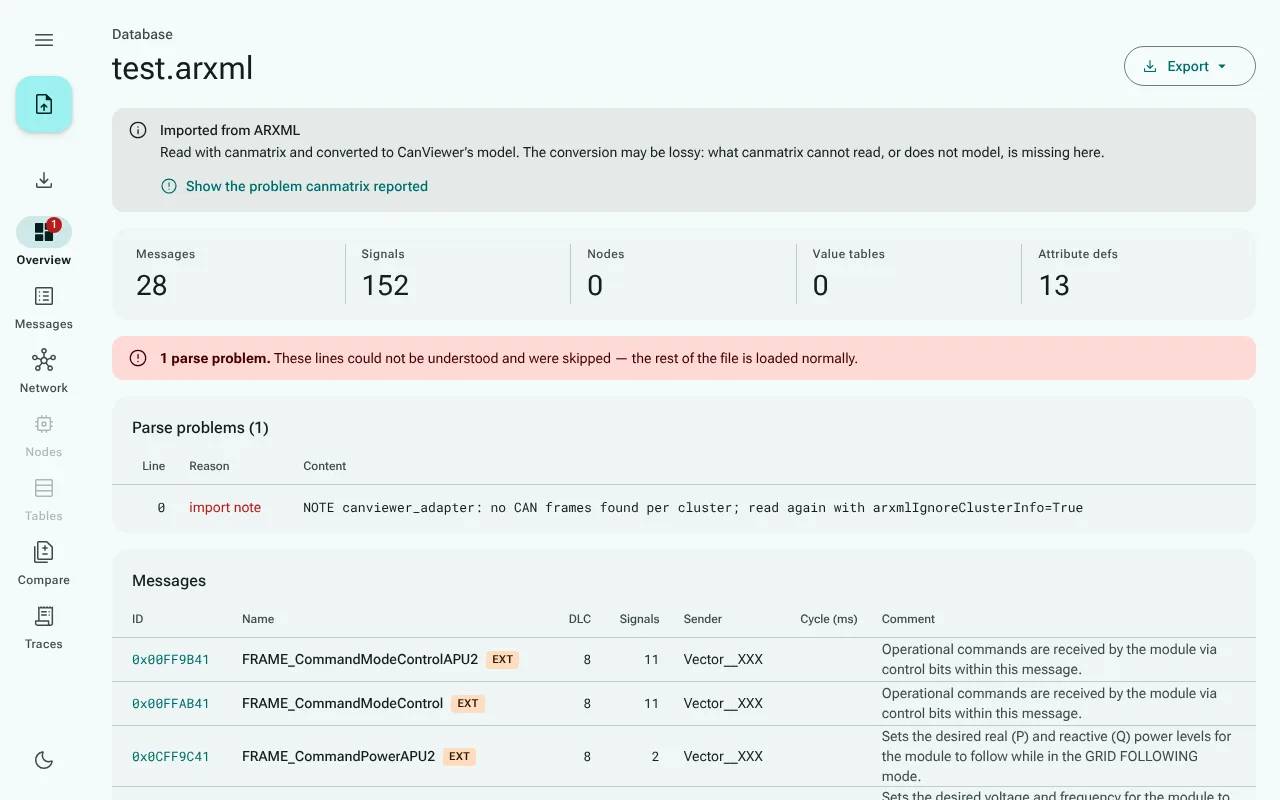
Its source, on the overview: Imported from ARXML (or the format it came in), with a note that the conversion to CanViewer's model may be lossy, and a link to the problems canmatrix reported.
A choice of cluster. Where a file describes several buses (clusters), as ARXML, KCD and FIBEX files can, the overview lists them, and you pick the one to show. The first one with messages is shown to start with. cantools'
the_homer.kcdholds three:

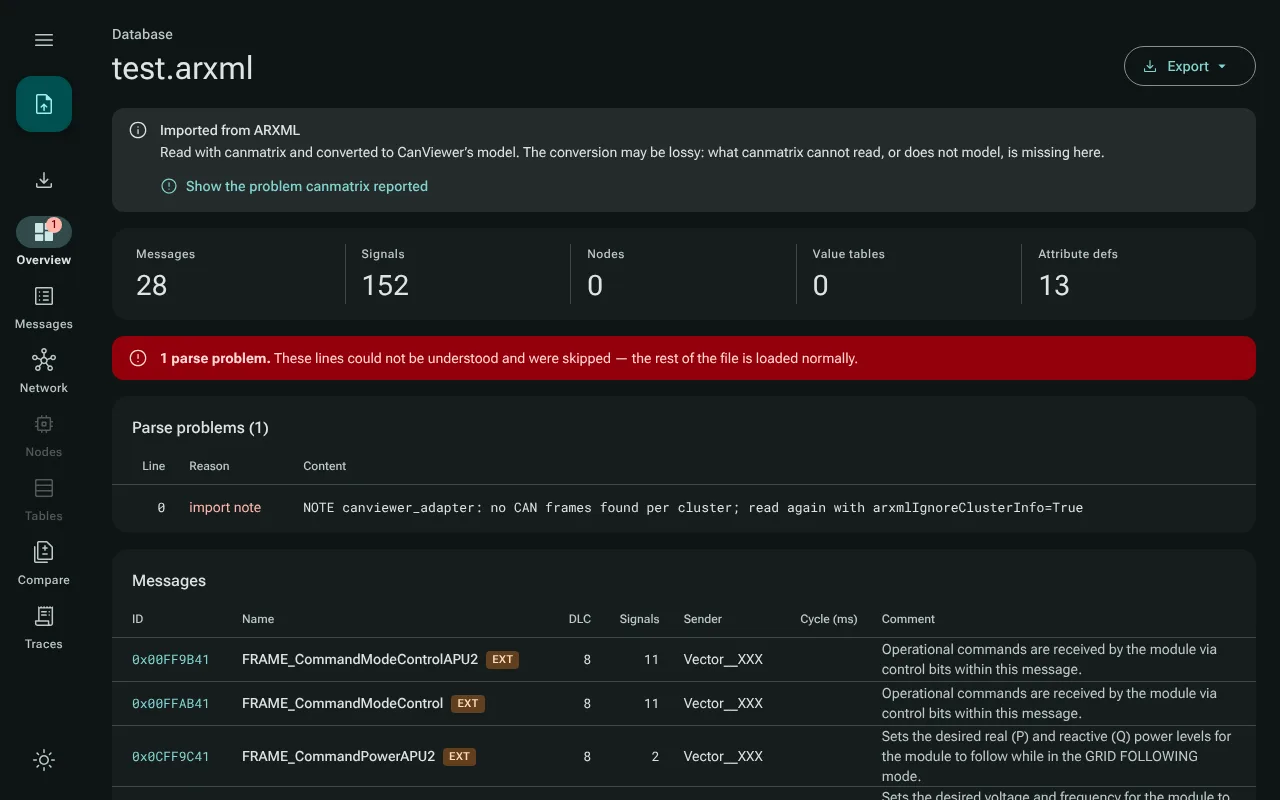
Every warning or error canmatrix reported, and every line it dropped, as a parse problem on the overview. The screenshot at the top of this page (
test.arxml) shows one: the file was read a second time with the cluster information ignored.No invented values: what the file does not say stays empty.
The file comes back
An imported file is restored when you reload the page or open the app again, like a DBC file: CanViewer keeps its bytes in your browser's IndexedDB, on your machine only, with the cluster you picked and the view you were on. A restore reads the file through canmatrix again, so it needs the runtime too; offline, that works once the runtime and the format's support have been downloaded before.
How well each format comes across is in the format reference.
Limits
- One cluster is shown at a time. Comparing two clusters of one file is not possible; compare two files instead.
- What canmatrix does not read, CanViewer cannot show: the format reference measures it for each format.